
If you’ve ever stared at a nutrition label wondering whether those 2,000 daily calories actually apply to you, you’re asking the right question. The best way to calculate calories for losing weight isn’t about finding a magic number; it’s about understanding how your unique body burns energy and creating a sustainable deficit that respects your metabolism.

Most people fail at calorie counting not because they lack willpower, but because they’re working with generic estimates that ignore their individual physiology. The internet is flooded with “one-size-fits-all” calculators that promise rapid results, yet leave you hungry, frustrated, and stuck on a plateau after three weeks.
This guide cuts through the noise. We’ll explore evidence-based methods to determine your true caloric needs, examine the limitations of popular formulas, and build a personalized approach that supports lasting fat loss without destroying your relationship with food.
Why Generic Calorie Advice Falls Short
Before diving into calculations, let’s address why standard recommendations often miss the mark.
The FDA’s 2,000-calorie guideline was created in the 1990s as a simplified reference for food labels—not as a personalized prescription. It assumes an average adult with moderate activity, but “average” encompasses enormous variation in body composition, age, hormonal health, and daily movement patterns.
Research consistently shows that individual energy expenditure can vary by 20-30% from standardized predictions. Factors like thyroid function, muscle mass, sleep quality, and even gut microbiome diversity influence how many calories you actually burn at rest.
Consider this: two people weighing 160 pounds might have vastly different metabolic rates. One could be a sedentary office worker with low muscle mass burning 1,400 calories at rest. Another might be an active individual with significant lean tissue burning 1,800 calories doing absolutely nothing. Give both the same 1,500-calorie target, and one person loses weight steadily while the other gains—or worse, triggers metabolic adaptation that stalls progress entirely.
This variability explains why your coworker’s success with a 1,200-calorie diet might spell disaster for your energy levels and hormonal health. The best way to calculate calories requires moving beyond population averages to individual assessment.
Understanding Your Energy Equation
Weight loss fundamentally requires consuming fewer calories than you expend. However, the “calories out” side of this equation involves multiple components that most calculators oversimplify.
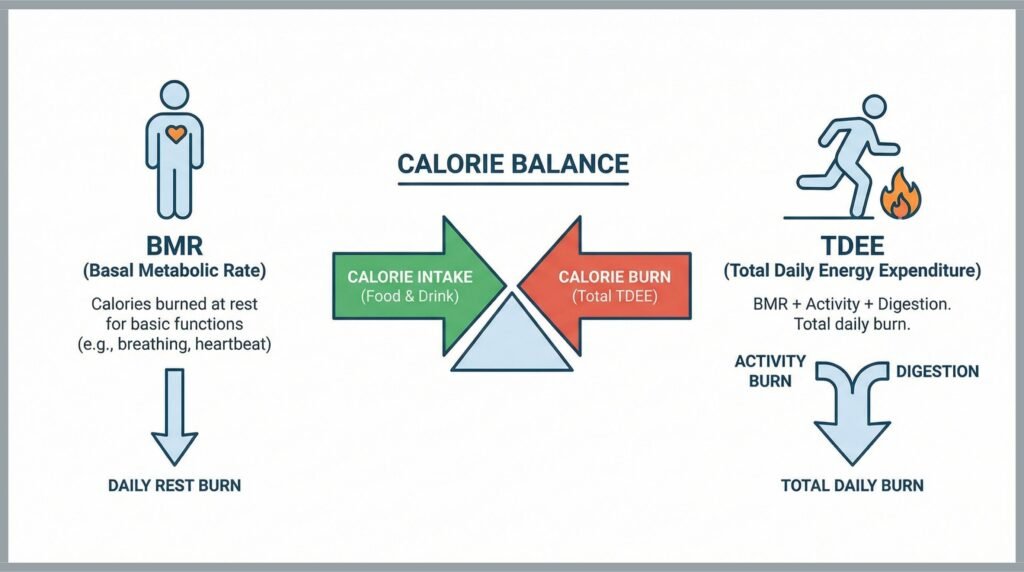
Total Daily Energy Expenditure (TDEE)
Your TDEE represents everything you burn in 24 hours and comprises four elements:
Basal Metabolic Rate (BMR): The energy required to keep you alive, breathing, circulating blood, cellular repair. This accounts for 60-75% of daily expenditure for most people. BMR correlates strongly with lean body mass; more muscle means higher baseline burning.
Thermic Effect of Food (TEF): Digesting, absorbing, and processing nutrients requires energy. Protein has the highest thermic cost (20-30% of its calories), followed by carbohydrates (5-10%) and fats (0-3%). This is why macronutrient composition matters beyond simple calorie counts.
Exercise Activity Thermogenesis (EAT): Dedicated workouts, running, lifting, cycling, contribute relatively little to weekly expenditure for most people, typically 5-15% of TDEE unless you’re training hours daily.
Non-Exercise Activity Thermogenesis (NEAT): The dark horse of calorie burning. Fidgeting, standing, walking to your car, household chores, this unconscious movement varies wildly between individuals and can differ by 2,000 calories daily between people of the same size.
👉 Understanding Metabolic Adaptation and Weight Loss Plateaus
When calculating your needs, recognize that TDEE fluctuates. Stress, sleep deprivation, and menstrual cycles can temporarily alter expenditure by 5-10%. The best way to calculate calories acknowledges these biological realities rather than treating metabolism as a static calculator.
Evidence-Based Calculation Methods
Let’s examine the most reliable approaches, from quick estimates to precise tracking protocols.

Method 1: The Mifflin-St Jeor Equation (Research Standard)
Developed in 1990 and validated in multiple studies, this formula provides more accurate BMR estimates than older alternatives like Harris-Benedict, particularly for overweight and obese populations.
For men:
BMR = (10 × weight in kg) + (6.25 × height in cm) – (5 × age in years) + 5
For women:
BMR = (10 × weight in kg) + (6.25 × height in cm) – (5 × age in years) – 161
Example calculation for a 35-year-old woman, 165 cm, 70 kg:
- (10 × 70) = 700
- (6.25 × 165) = 1,031.25
- (5 × 35) = 175
- 700 + 1,031.25 – 175 – 161 = 1,395 calories (BMR)
To estimate TDEE, multiply BMR by an activity factor:
- Sedentary (desk job, little exercise): × 1.2
- Lightly active (1-3 days/week exercise): × 1.375
- Moderately active (3-5 days/week exercise): × 1.55
- Very active (6-7 days/week hard exercise): × 1.725
- Extremely active (physical job + training): × 1.9
Continuing our example with light activity: 1,395 × 1.375 = 1,918 calories TDEE
For weight loss, subtract 300-500 calories: target range 1,418-1,618 calories
Limitations to note: This formula estimates BMR within 10% accuracy for about 70% of people, but underestimates needs for the very muscular and overestimates for those with higher body fat percentages. It also cannot account for metabolic adaptation from chronic dieting.
👉 Mifflin-St Jeor validation study published in the American Journal of Clinical Nutrition, 1990
Method 2: The Katch-McArdle Formula (Body Composition-Based)
If you know your body fat percentage, this approach proves more accurate than weight-based formulas because it calculates based on lean body mass (LBM)—the metabolically active tissue that actually burns calories.
Formula:
BMR = 370 + (21.6 × LBM in kg)
To find LBM:
LBM = total weight in kg × (1 – body fat percentage as decimal)
Example for a 80kg male at 20% body fat:
- LBM = 80 × 0.80 = 64 kg
- BMR = 370 + (21.6 × 64) = 1,752 calories
This method shines for individuals with above-average muscle mass or those who have lost significant weight (and thus have different body composition than their scale weight suggests). However, accurate body fat measurement requires DEXA scans, hydrostatic weighing, or skilled caliper use—bioelectrical impedance scales often carry 5-8% error margins.
Method 3: The Cunningham Equation (Athletic Populations)
For highly active individuals or athletes with substantial lean mass, Cunningham’s formula addresses the limitations of population-based equations:
For men and women:
RMR (Resting Metabolic Rate) = 500 + (22 × LBM in kg)
This typically yields higher estimates than other formulas for muscular individuals, preventing the metabolic slowdown that occurs when active people underfeed relative to their true expenditure.
Method 4: Tracking-Based Calculation (The Gold Standard)
While formulas provide starting points, the most accurate way to determine your maintenance calories requires empirical data. This 3-4 week protocol eliminates estimation errors:
Week 1-2: Baseline Tracking
- Eat normally without restriction
- Track every bite using a digital food scale and app like Cronometer or MacroFactor
- Weigh yourself daily under consistent conditions (morning, post-bathroom, pre-food)
- Calculate weekly average weight
Week 3-4: Adjustment Phase If:
- Weight stayed stable, your tracked intake equals maintenance
- You lost 0.5-1 pound, you’re in a 250-500 deficit already
- You gained, reduce by 300-500 calories for true maintenance
Example:
You tracked 2,400 calories daily for two weeks. Weight remained stable. Your true TDEE is approximately 2,400—regardless of what calculators suggested.
This method captures your actual metabolic rate, including genetic factors, thyroid function, and NEAT variations that formulas cannot predict. The downside? It requires patience and honest tracking.
👉 How to Track Calories Accurately: Common Mistakes and Solutions” guide
Creating Your Deficit: How Low Should You Go?
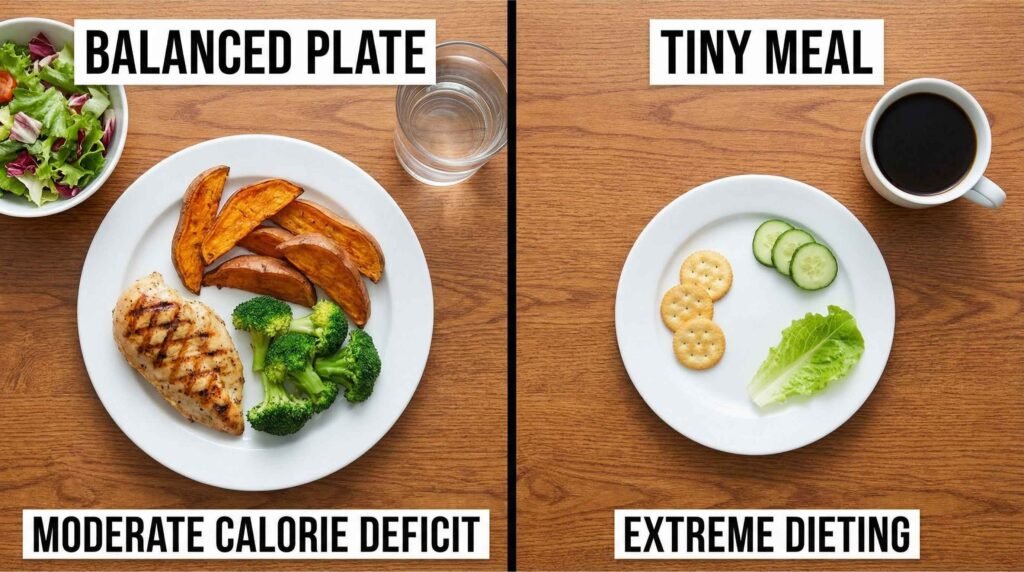
Once you establish maintenance, the next question involves deficit size. Conventional wisdom suggests 3,500 calories equals one pound of fat, implying a 500-calorie daily deficit yields one pound weekly loss. Reality proves more nuanced.
Research indicates actual weight loss often falls 15-20% below predicted rates due to metabolic adaptation, water retention, and compliance gaps. Moreover, aggressive deficits trigger biological resistance:
- Leptin levels drop, increasing hunger
- Thyroid hormones downregulate, reducing expenditure
- Muscle protein synthesis becomes impaired
- Cortisol rises, promoting water retention and abdominal fat storage
Evidence-Based Deficit Recommendations:
Conservative Approach (10-15% deficit):
- Best for: Those with history of yo-yo dieting, individuals over 40, people with high stress or poor sleep
- Expected loss: 0.5-0.75 pounds weekly
- Advantages: Minimal hunger, preserves muscle, sustainable long-term
Moderate Approach (20-25% deficit):
- Best for: Healthy individuals with 20+ pounds to lose, good sleep habits, established training routine
- Expected loss: 1-1.5 pounds weekly
- Advantages: Visible progress, manageable hunger with proper food choices
Aggressive Approach (30%+ deficit):
- Best for: Short-term use only (2-4 weeks), significant weight to lose, medical supervision
- Expected loss: 2+ pounds weekly initially
- Risks: Muscle loss, nutrient deficiencies, metabolic slowdown, rebound potential
For most people, the best way to calculate calories involves starting conservatively. You can always increase the deficit if progress stalls, but recovering from metabolic adaptation requires months of careful eating.
The Protein Priority: Beyond Calorie Counting
While total calories drive weight change, protein intake determines what kind of weight you lose. Inadequate protein during a deficit leads to muscle catabolism, reducing metabolic rate and creating the “skinny-fat” outcome many dieters experience.
Current research supports 0.7-1 gram per pound of goal body weight (or 1.6-2.2 grams per kg) for those in a calorie deficit. Higher intakes (up to 1.2g/lb) may benefit those in steep deficits or with significant muscle mass to preserve.
Practical protein targets:
- 150-pound target weight: 105-150g protein daily
- 180-pound target weight: 126-180g protein daily
Distributing protein across 3-4 meals optimizes muscle protein synthesis. A breakfast containing 30-40g protein (eggs, Greek yogurt, protein smoothie) proves more anabolic than carb-heavy alternatives.
This protein emphasis serves another purpose: satiety. Protein suppresses ghrelin (hunger hormone) more effectively than carbohydrates or fats, making deficit adherence significantly easier. When calculating your calorie target, allocate protein first, then fill remaining calories with carbohydrates and fats based on preference and performance needs.
👉 Complete Guide to Protein Timing and Distribution for Fat Loss
Adjusting for Real-World Variables
Static calorie targets fail because human metabolism isn’t static. Several factors require ongoing adjustment:

Menstrual Cycle Considerations
For premenopausal women, the luteal phase (week before menstruation) typically increases TDEE by 100-300 calories while simultaneously intensifying cravings. Rather than fighting biology with rigid targets, consider:
- Maintenance or slight deficit during luteal phase
- Stricter deficit during follicular phase when appetite is naturally lower
- Increased magnesium and omega-3 intake to mitigate cravings
Sleep and Recovery
Sleep deprivation reduces next-day calorie expenditure by 5-20% through decreased NEAT and impaired glucose metabolism. It also increases hunger hormones by 15-20%. If you’re sleeping less than 7 hours consistently, your calculated deficit may actually be maintenance or surplus.
Adjustment protocol: Add 100-150 calories to your target on days following poor sleep, focusing on protein and fiber to manage increased appetite.
Training Periodization
Heavy resistance training temporarily increases metabolic rate (EPOC) by 5-10% for 24-48 hours. Endurance athletes may burn 1,000+ additional calories on long training days.
Rather than averaging these into a flat daily target, consider:
- Linear approach: Same calories daily, accepting faster loss on rest days, slower on training days
- Calorie cycling: Higher intake (at or near maintenance) on training days, lower on rest days
- Weekly averages: Track intake across 7 days rather than obsessing over daily precision
The best way to calculate calories accommodates your lifestyle patterns rather than forcing arbitrary consistency.
Common Calculation Mistakes to Avoid
Even with accurate formulas, these errors derail progress:
Overestimating Activity: The “moderately active” multiplier assumes 3-5 days of purposeful exercise plus general movement. One hour at the gym followed by 8 hours sitting doesn’t qualify. When uncertain, choose the lower activity category.
Ignoring Liquid Calories: Coffee drinks, smoothies, alcohol, and sodas often contribute 300-500 calories that “don’t count” mentally but absolutely count metabolically. Track everything that isn’t water or zero-calorie beverages.
Underestimating Portion Sizes: That “tablespoon” of peanut butter is likely two. That “medium” apple is actually large. Digital food scales reveal that eyeballing portions creates 20-40% tracking errors.
Chronic Undereating: Perpetually eating 1,200 calories or less triggers metabolic adaptation that makes eventual weight regain inevitable. If you’ve been dieting for months without breaks, your calculated maintenance may no longer reflect reality.
Neglecting Weekly Averages: Weight fluctuates 2-4 pounds daily due to sodium, carbohydrates, hormones, and digestive contents. Judging progress by single weigh-ins rather than weekly trends leads to unnecessary restriction or panic.
Practical Implementation: Your 4-Week Start Protocol
Ready to apply these principles? Here’s your step-by-step launch:

Week 1: Assessment
- Choose your calculation method (Mifflin-St Jeor for most, Katch-McArdle if you know body fat)
- Be conservative with activity multipliers
- Set protein target at 0.8g per pound goal weight
- Track everything without changing eating habits
Week 2: Baseline
- Continue tracking current intake
- Weigh daily, calculate weekly average
- Note energy levels, hunger, sleep quality
- Identify highest-calorie “easy wins” (liquid calories, large portions, frequent snacking)
Week 3: Deficit Initiation
- Reduce maintenance by 15-20%
- Prioritize protein at each meal
- Fill remaining calories with vegetables, whole grains, healthy fats
- Maintain training routine
Week 4: Evaluation If:
- Compare weekly average weight to Week 2
- Down 0.5-1.5 pounds, maintain current target
- No change, verify tracking accuracy before cutting further
- Down >2 pounds or experiencing excessive hunger/fatigue, increase by 100-200 calories
👉 Fitsola’s 30-Day Sustainable Weight Loss Meal Plan
When to Seek Professional Guidance
While self-calculation works for many, certain situations warrant expert input:
- History of eating disorders or disordered eating patterns
- Thyroid conditions or suspected hormonal imbalances
- PCOS, menopause, or other endocrine considerations
- Medications affecting metabolism (antidepressants, antipsychotics, beta-blockers)
- Chronic fatigue, hair loss, or menstrual irregularities during dieting
- Need to lose >50 pounds or achieve <12% body fat (men) / <20% (women)
Follow a Proven 4-Week Blueprint
Structured guidance makes the Best Way to Calculate Calories easier to follow and stick to.
👉 Download the Plan
Registered dietitians can perform indirect calorimetry (measuring actual oxygen consumption) to determine precise metabolic rate, eliminating estimation entirely.
The Sustainability Factor: Beyond the Numbers
The mathematically “optimal” calorie target fails if you cannot adhere to it for months. The best way to calculate calories ultimately prioritizes consistency over perfection.

Signs your target is sustainable:
- Hunger is manageable between meals
- Energy supports daily activities and training
- Sleep quality remains good
- Social eating is possible with planning
- You do not obsess about food constantly
Red flags requiring adjustment:
- Persistent fatigue or irritability
- Intense cravings or binge episodes
- Performance decline in workouts
- Obsessive thoughts about food
- Disrupted menstrual cycles (women)
Remember: a 300-calorie deficit you maintain for 6 months outperforms a 700-calorie deficit abandoned after 3 weeks.
Make It Sustainable
The Best Way to Calculate Calories is the one you can maintain for life, not just 30 days.
👉 Start Sustainable Weight Loss
Conclusion: Your Personalized Path Forward
The best way to calculate calories for losing weight combines scientific estimation with individual adjustment. Start with validated formulas like Mifflin-St Jeor, apply conservative activity multipliers, prioritize protein, and—most importantly—track real-world results to refine your numbers.
Weight loss is not a mathematical equation solved once; it’s a biological process requiring ongoing calibration. Your calculated starting point matters less than your willingness to adjust based on feedback.
The goal isn’t perfection. It’s finding a sustainable deficit that respects your metabolism, preserves your muscle, and fits your life well enough to maintain until you reach your goal—and beyond.
Ready to stop guessing and start progressing? At Fitsola Health & Fitness, we believe sustainable weight loss comes from understanding your unique body, not following generic templates. Explore our science-backed resources on nutrition timing, metabolic health, and building habits that last. Your journey to a healthier weight starts with knowledge, and we’re here to provide it, one evidence-based step at a time.
Browse the latest articles on the Fitsola Health & Fitness blog for expert tips on fat loss, muscle building, recovery, healthy aging, and sustainable wellness strategies.



[…] When discussing protein timing around training. […]